I see lots of people still struggle with the German adjectives and especially the fact that there are three tables, one for each of definite articles, indefinite articles and when there’s no article, for 48 separate inflections.
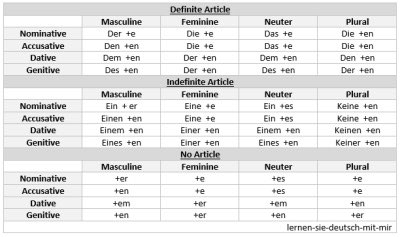
It looks pretty intimidating and back in school my brain refused to do learn this. I crammed it for a test, immediately forgot it after and German classes turned into agony.
There are various mnemonics going around to make the table easier but I’m not in favor of rote memorization if there’s also a logic behind something. As with all language, the entire thing is based on the principle of energy conversation while maintaining essential information and harmony. That’s my non-linguist intuition. Linguists feel free to chime in.
The entire table can be boiled down to five rules.
- Definite nom./acc. singular: all -e (because a definite article has all the information and is leading, so no further decoration or information required on the adjective) except for masc. acc. which is -en (because acc always has -en and it sounds weird without it)
- Indefinite nom./acc. singular: all congruent with the article: einer gut er Mann, für ein en gut en Mann, ein e gut e Frau, für ein e gut e Frau etc. (because the article still has all the information but it is weaker/indefinite so the adjective helps out)
- Definite and indefinite gen./dat. singular: all -en (all the information is in the article so no need to repeat it but good to have some differentiation from the nom./acc. cases)
- Definite and indefinite plural: all -en (because it’s plural)
- No article: the adjectives take the endings that would normally have been carried by the article (because there is no article and otherwise the case information would not be there) except for masc./neut. gen. where the -s is on the noun
That’s it. I hope this adds some logic to something that otherwise feels totally random for German learners.
With practice you can look these inflections up in your head and with even more practice, anytime somebody uses the wrong inflection, it starts to sound wrong (that lack of harmony), just like it would to a native speaker.